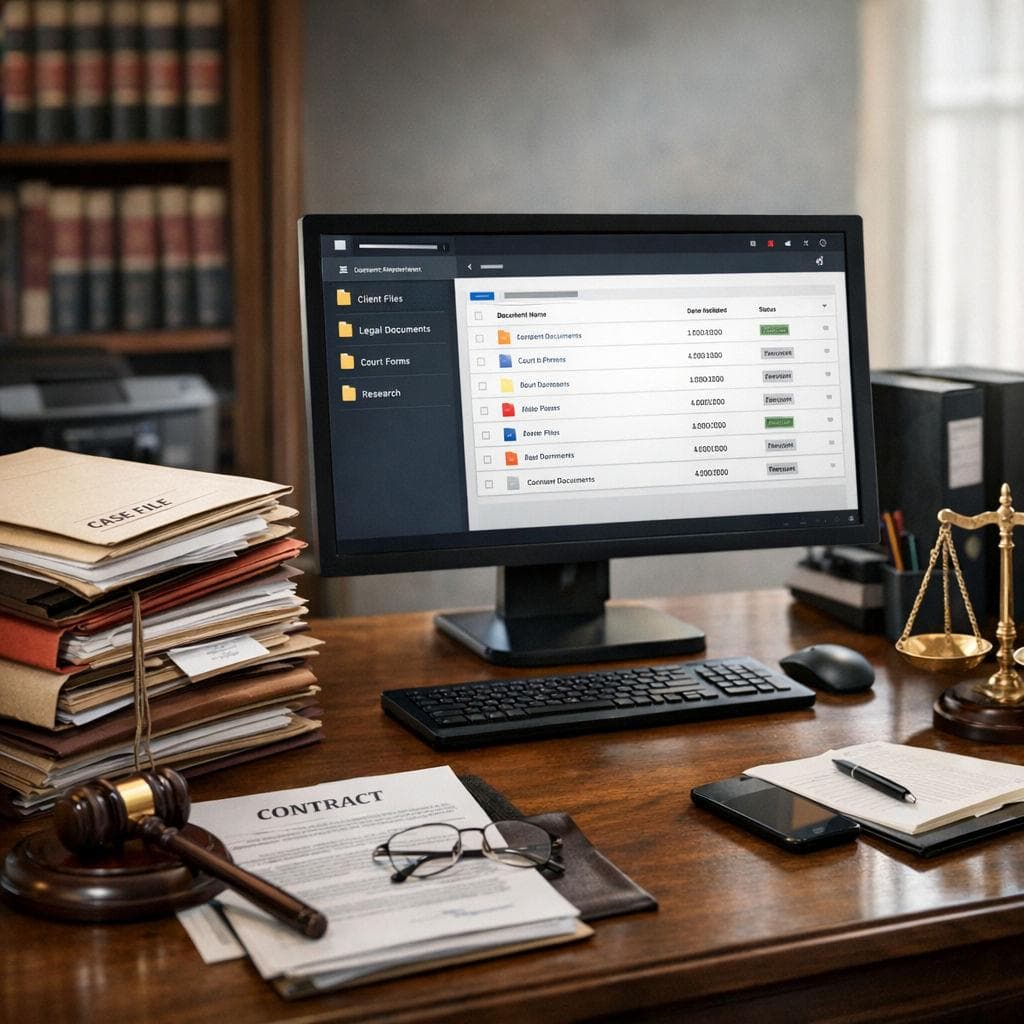
Document Management System for Law Firms | Stacknatic
Document Management System for Law Firms
Published on:
Document Management System for Law Firms: What to Look For (and Why It Matters)
Law firms don’t just “store documents.” They manage sensitive, time-critical records that may later be scrutinised by clients, regulators, opposing counsel—or a court.
That difference matters.
A generic cloud drive can hold files, but it often won’t give you the controls a modern law practice needs: confidentiality for privileged material, a clear chain of custody, defensible integrity, and fast collaboration across matters.
This guide explains what a Document Management System (DMS) should do for a law firm today—and why purpose-built platforms like Lexkeep are increasingly preferred when evidentiary strength and compliance are non‑negotiable.
Why Law Firms Need More Than “Storage”
Law firm documents live longer, travel further, and are challenged more often than typical business files. Think:
pleadings and exhibits
deeds, assignments, and closing documents
privileged advice and internal memos
witness statements, interview recordings, deposition video
e‑discovery exports and forensic artefacts
When something goes wrong, the questions are predictable:
Who accessed this file—and when?
Can you prove it hasn’t been altered?
Can you prove when this version existed?
Can you show you handled it securely and consistently?
A strong DMS is your answer to those questions.
The DMS Checklist for Modern Law Firms
1) Matter-Based Structure (not just folders)
A law firm DMS should support matter-centric work:
Lexkeep approach:Cohorts—structured collaboration groups mapped to matters, deal teams, investigations or practice groups—with granular permissions.
2) Confidentiality Controls That Match Legal Reality
Legal confidentiality isn’t just a “security preference.” It’s professional duty.
Minimum baseline:
encryption at rest and in transit
strong authentication and role-based access
controlled external sharing (not “anyone with the link”)
For highly sensitive matters, many firms now want:
end‑to‑end encryption (E2EE) so the platform cannot access plaintext content
Lexkeep approach: AES‑256 encryption at rest in secure EU cloud storage, TLS in transit, and optional on-device E2EE for privileged or high-risk files.
3) Integrity You Can Prove (Not Just “Version History”)
Version history is useful, but it’s not the same as defensible integrity—especially when an opposing party questions authenticity.
A modern DMS should support:
cryptographic hashing (file fingerprints)
tamper-evident logging (audit trails you can trust)
independent timestamping for “proof of existence”
Lexkeep approach: each upload generates a cryptographic fingerprint that can be anchored on a public blockchain, creating an immutable, independent timestamped record. Any unauthorised change is immediately detectable by re-hashing and comparing.
4) Chain of Custody for Digital Evidence
Chain of custody is not only for criminal matters. It matters in:
internal investigations
regulatory compliance
employment disputes
IP priority and ownership challenges
high-stakes civil litigation
A DMS should record:
who uploaded evidence
who accessed/shared it
what changed (and whether changes are allowed)
when retention holds were applied
Lexkeep approach: tamper-evident audit trails tied to user accounts and cohorts, with one-click File Integrity Certificates to support litigation and regulatory submissions.
5) Retention That Works for Lawyers (WORM + Legal Hold)
Firms need both deletion and preservation:
delete when required by policy or client instructions
preserve when litigation is pending (legal hold)
maintain defensible retention schedules
Lexkeep approach: WORM-style storage for sensitive files (soft delete first; full erasure can take up to 12 months due to retention and backup constraints) plus higher-tier legal hold features for investigations and disputes.
6) Data Residency and Compliance Readiness
Many law firms now have strong expectations about:
EU/UK data residency
GDPR compliance posture
vendor due diligence responses
audit exports for internal risk teams
Lexkeep approach: EU-based hosting by default and a platform designed to support auditability, retention discipline, and secure collaboration.
A Practical “Day One” DMS Rollout for a Law Firm
If you’re adopting a DMS, don’t start with everything. Start with one workflow where proof and confidentiality matter:
controlled external sharing with clients and counterparties
Option C: Internal investigation workspace
restricted cohort membership
E2EE for sensitive files
auditable access changes and preservation
Lexkeep makes this approach easy: create a cohort, invite the right people, upload once, and generate certificates when needed.
Why Many Firms Choose Lexkeep as Their Evidence-Grade DMS
A typical DMS optimises for productivity and document collaboration.
Lexkeep optimises for defensibility:
strong encryption for confidentiality
optional E2EE for highly sensitive matters
blockchain-anchored fingerprints for integrity and timing
tamper-evident audit trails for chain-of-custody narratives
WORM-style retention for evidence preservation
matter-centric cohorts for controlled collaboration
Legal hold to preserve files (suspend deletion and retention rules when litigation or investigations are anticipated)
In short: it’s a document system designed around the question a judge or regulator will ask later—“How do you know this is authentic?”
Conclusion
For law firms, a document management system is not just an operational tool. It’s a risk-control system.
The best time to strengthen confidentiality, integrity, and chain of custody is before you have a dispute—not after opposing counsel starts poking holes in your record-keeping.
If your firm wants a modern DMS that combines secure storage, controlled collaboration, and verifiable integrity, Lexkeep offers an evidence-grade approach that fits legal workflows from day one.